


Original article: Parlamentarios progresistas emplazan a la derecha por ley de conmutación de penas y exigen que expliquen “cuánto costará y cómo pretenden financiarlo”
«Legal Aberration and Gateway to Impunity»: Progressive Legislators Attack Law Passed in the Senate
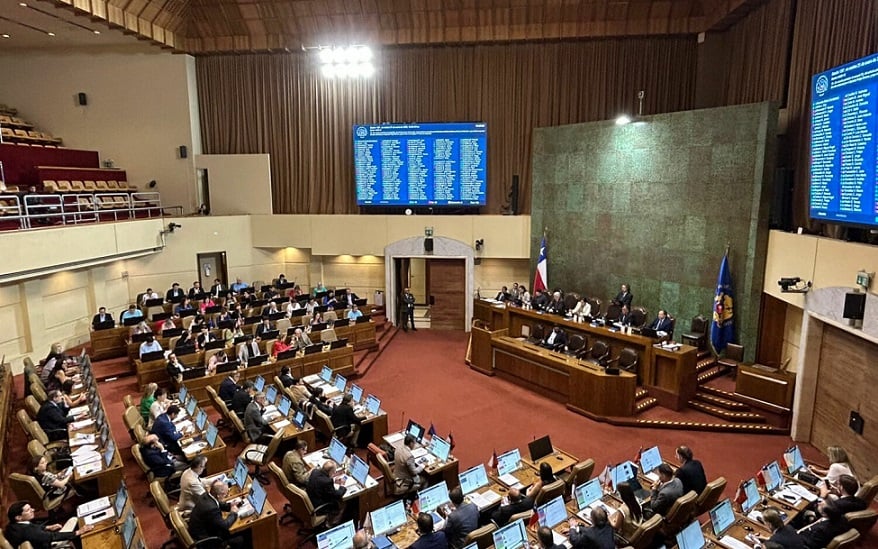
The approval of a bill in the Senate aimed at regulating the suspension and alternative compliance of prison sentences for inmates with terminal illnesses, severe disabilities, or those over a certain age has sparked intense political controversy. Now set for discussion in the Chamber of Deputies, the proposal allows certain prisoners to serve their sentences outside of prison—such as under total house arrest—based on «humanitarian and social reintegration» arguments.
The bill argues that the Chilean prison system lacks a comprehensive execution law and that many norms affecting the rights of incarcerated individuals are based on administrative regulations, which, according to its authors, are incompatible with international human rights standards. It also contends that the aging of the prison population, overcrowding, and lack of adequate medical care justify alternative compliance modalities for elderly inmates or those with serious illnesses.
However, the initiative has opened a significant political and human rights front. Its own justification acknowledges that a significant portion of potential beneficiaries includes those convicted of human rights violations during the dictatorship, many of whom are held in facilities such as Punta Peuco or Colina. Progressive sectors have warned that the proposal could mean an attempt to ease the effective enforcement of sentences for particularly serious and imprescriptible crimes, straining Chile’s international commitments regarding transitional justice and victim reparations.
«How much will it cost and how do you intend to fund it?»
Deputy Jaime Araya from Antofagasta questioned the funding of the proposal and directly challenged the right-wing: «I demand that the right explain how much the commutation law passed in the Senate will cost and how they plan to finance it».
He further added that the project itself states that life in prison should resemble life outside, asking: «Where will the resources for that come from? Will they create luxury prisons for rapists, murderers, and hitmen?» Araya concluded, stating that while penitentiary benefits are being discussed, «thousands of vulnerable children in Mejor Niñez continue to wait for dignity and support from the State. The priorities are completely misplaced».
In another tweet, Araya commented: «Pedophiles, rapists, hitmen, drug traffickers, and sexual abusers on the streets, all to let loose the degenerates who violated women with dogs and put mice in their vaginas, to set free their friends who are murderers, torturers, and rapists, will put Chile’s security at risk—that’s what the senators of Kast approved.»
Deputy Daniel Manouchehri from the Coquimbo Region described the initiative as extremely serious and stated that Congress cannot legislate norms favoring criminals. «When the laws are written by criminal lawyers, Congress ceases to represent Chile. This is extremely grave. It must be thoroughly investigated», he affirmed.
He added that, as the facts are clarified, «that project must be withdrawn. Chile cannot legislate legal aberrations tailored for psychopaths and criminals».
From the Valparaíso Region, Deputy María Francisca Bello also harshly criticized the approval in the Senate and urged everyone to remember the votes. «Let’s never forget these votes. When discussing security, decisions matter», she pointed out.
In her view, there is a clear political contradiction: «There can be no double talk: one cannot demand a tough stance while simultaneously pushing for norms that open the door to benefits for those convicted of heinous crimes. Security is built on the side of the victims».
Deputy Lorena Fries directly pointed to the underlying motive of the project, claiming that its true aim would be to benefit those convicted of crimes against humanity. «Without remorse, collaboration, or effective compliance of sentences, there can be no prison benefits for human rights violators,» she asserted. According to the deputy, «the true purpose of this project, approved today in the Senate, is to send home the criminals from Punta Peuco.»
Fries insisted that the proposal attempts to disguise its objective by extending benefits to other crimes. «We always knew: the true intent behind the sentence commutation project is for human rights criminals to serve their time at home. To hide this, it releases other murderers and rapists,» she stated, adding that, in her view, the initiative constitutes «a legal monstrosity» that reveals an attempt to move toward impunity under the guise of humanitarian reasons.
See also the video with statements from Lorena Fries